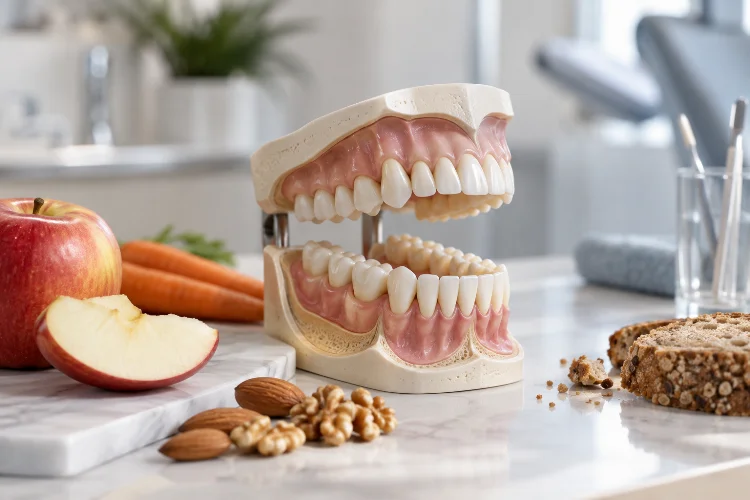
Think about what happens when you bite into an apple. Your front teeth cut through the skin, your pointed teeth help tear pieces apart, and the teeth farther back crush everything into smaller, easier-to-swallow pieces.
That process feels automatic, but it actually depends on several specialized teeth working together.
Understanding the different types of teeth and their functions makes it easier to appreciate why human teeth come in so many shapes and sizes.
Unlike some animals that have teeth designed mainly for tearing or grinding, humans eat a varied diet. Our mouths therefore contain several kinds of teeth, each adapted for a particular job.
Most adults can have up to 32 permanent teeth: eight incisors, four canines, eight premolars, and 12 molars when all four wisdom teeth are present. Children normally have 20 primary teeth and do not have premolars.
Let’s look at what makes each type unique and why all of them matter.
Why Do Humans Have Different Types of Teeth?
Human teeth are not simply identical structures placed around the jaw. Their shapes reflect what they are designed to do.
The front teeth tend to be thinner and sharper because they handle the first stage of eating. Teeth toward the back become broader and stronger because they must withstand much greater chewing pressure.
This division of labor makes eating more efficient. Instead of asking one tooth shape to perform every task, the mouth uses a combination of cutting, tearing, crushing, and grinding.
Your teeth also contribute to speech, facial appearance, and maintaining proper spacing inside the jaw. Teeth are anchored into the upper jaw, called the maxilla, and lower jaw, called the mandible.
Although every tooth contains similar basic structures such as enamel, dentin, pulp, and roots, its external design can be quite diferent depending on its function.
Incisors: The Cutting Teeth at the Front
Incisors are the teeth you probably notice first when someone smiles.
Most adults have eight incisors: four in the upper jaw and four in the lower jaw. They are divided into central incisors, located directly in the middle, and lateral incisors beside them.
Their relatively thin, blade-like edges are designed primarily for cutting and biting food.
Imagine taking a bite from an apple, sandwich, carrot, or piece of bread. Your incisors make the first cut, separating a manageable piece from the rest of the food.
They also play an important role in appearance and speech. Because incisors sit at the front of the mouth, changes in their position, shape, or loss can influence how certain sounds are pronounced.
Permanent incisors generally begin appearing during early childhood as baby front teeth fall out. Eruption timing varies, but permanent incisors commonly emerge during roughly the early elementary-school years.
Canines: Built for Gripping and Tearing
Move one tooth farther away from the incisors and you will reach the canines.
Humans normally have four canine teeth: one on each side of the upper and lower dental arches. Their recognizable pointed shape explains why they are sometimes compared with animal fangs.
Canines are primarily designed to grip and tear food. Their shape can be particularly useful when eating foods that require pulling or tearing before chewing.
They also have considerable strenght. According to the MSD Manual, canine teeth have particularly large and strong roots, helping them remain securely anchored within the jaw.
Canines also help guide the way the upper and lower teeth move against each other during certain jaw movements. Their position creates a transition between the thinner front teeth and the broader chewing teeth farther back.
Because of their prominent position and long roots, keeping canine teeth healthy is an important part of maintaining a stable bite.
Premolars: The Versatile Middle Teeth
Premolars sit between the canines and molars and combine characteristics of both.
Adults generally have eight premolars, with two on each side of the upper jaw and two on each side of the lower jaw. They are also sometimes called bicuspids.
Instead of having the thin cutting edge of an incisor or the single prominent point associated with a canine, premolars usually have broader chewing surfaces with raised areas known as cusps.
This shape allows them to perform several tasks.
Premolars can help tear food coming from the canines, but they also begin crushing and grinding it before it reaches the molars. You might think of them as the transition zone in the chewing process.
Interestingly, children do not have primary premolars. Their baby molars are eventually replaced by permanent premolars, which typically erupt during later childhood.
That is one reason a child’s dental arrangement looks somewhat different from an adult’s.
Molars: The Heavy-Duty Grinding Teeth
Molars are the large teeth located at the back of the mouth.
When all permanent teeth are present, an adult may have 12 molars, including four third molars or wisdom teeth. Molars have wide chewing surfaces that make them particularly effective at crushing and grinding food.
After your incisors cut food and your canines and premolars break it down further, the molars handle much of the final mechanical processing.
1. Why Molar Surfaces Look Different
If you examine a molar, you will notice that its surface is not completely flat. Instead, it contains multiple peaks, grooves, and depressions.
These shapes improve grinding efficiency, almost like the textured surface of a kitchen grinding tool.
However, those grooves can also trap food particles and plaque. This helps explain why careful brushing of the back teeth is so essencial. Plaque bacteria can use sugars and starches from food to produce acids that damage enamel and eventually contribute to cavities.
2. What About Wisdom Teeth?
Wisdom teeth are simply the third and final set of permanent molars.
They commonly emerge much later than other teeth, often somewhere between the late teenage years and the twenties. Not everyone develops all four wisdom teeth, and some people develop none.
When there is insufficient space in the jaw, third molars may remain partially or completely unerupted and sometimes require evaluation by a dentist.
Baby Teeth and Adult Teeth Are Not Exactly the Same
Children normally develop 20 primary teeth, while a complete adult dentition can contain 32 permanent teeth.
Primary teeth include incisors, canines, and molars. What they do not include are premolars.
As children grow, primary molars eventually fall out and are replaced by permanent premolars. Meanwhile, permanent molars emerge farther back in the jaw rather than directly replacing baby teeth.
This distinction is important because parents sometimes assume that every permanent tooth appears only after a baby tooth falls out. The first permanent molars, for example, typically erupt behind the primary teeth at around five to seven years of age.
Baby teeth still perform important functions. They help children chew, speak, and maintain space in the jaw while permanent teeth continue developing.
How All Four Types Work Together When You Eat
The easiest way to understand dental function is to follow a normal bite of food.
Suppose you eat a crisp piece of apple. Your incisors first cut off a section. Your canines may help hold or tear the piece, while the premolars begin crushing it.
The food then moves toward the molars, where repeated chewing reduces it into much smaller pieces that are easier to mix with saliva and swallow.
No single type performs the entire job efficiently by itself.
This teamwork also explains why losing several teeth can affect more than appearance. Missing teeth may change how chewing forces are distributed and make certain foods more difficult to process.
Replacing missing teeth when appropriate can therefore contribute to both function and long-term oral maintainance. The best option depends on the individual’s dental condition and should be discussed with a dental professional.
Protecting Every Type of Tooth
Different tooth shapes can create different cleaning challenges.
Front teeth are relatively easy to reach, while molars sit farther back and contain grooves where plaque can accumulate. Areas between neighboring teeth are another challenge because ordinary toothbrush bristles may not clean them effectively.
The American Dental Association recommends brushing twice daily with fluoride toothpaste and cleaning between teeth every day. Regular dental visits, a balanced diet, and limiting frequent sugary snacks also support oral health.
Fluoride is particularly valuable because it strengthens enamel and can help reverse early stages of tooth decay by replacing minerals that have been lost.
Pay special attention to the chewing surfaces of premolars and molars, but do not neglect the gumline or spaces between teeth.
A good oral-care routine protects the entire system rather than focusing only on the teeth visible when you smile.
Understanding the different types of teeth and their functions shows just how carefully designed the human mouth is.
Incisors cut food, canines grip and tear it, premolars combine tearing with crushing, and molars provide the broad surfaces needed for powerful grinding.
Together, these teeth make eating efficient while also supporting speech, facial structure, and a balanced bite. Their different shapes also mean that each area of the mouth can have unique cleaning needs.
Protecting your teeth starts with simple habits: brush twice daily with fluoride toothpaste, clean between teeth, limit frequent sugary snacks, and schedule regular dental visits.
The next time you take a bite of food, pay attention to how your teeth work together. That everyday action is a surprisingly complex piece of human biology.